How Much Thai Baht Should I Carry for a Thailand Trip?
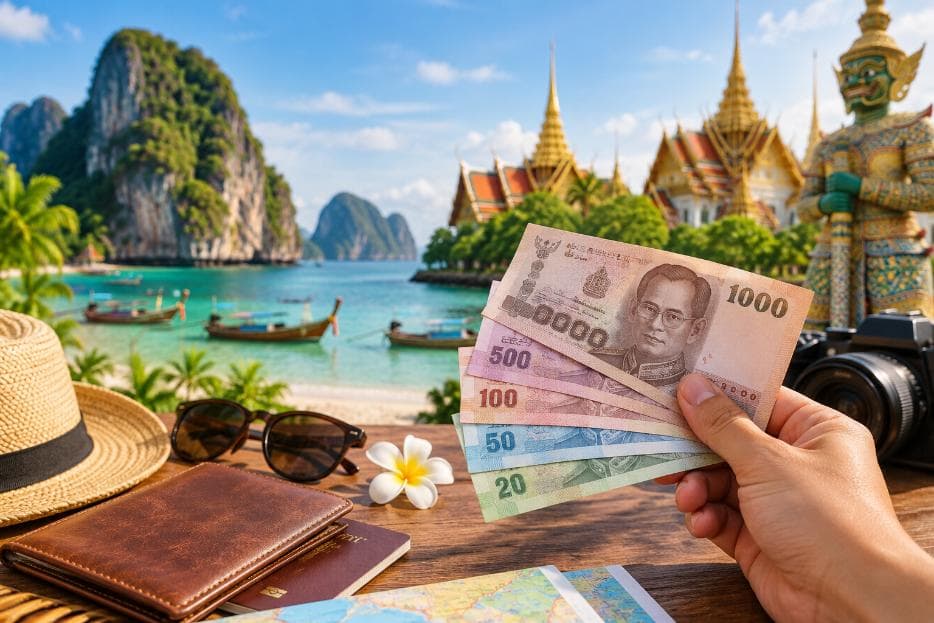
You've booked the flight. You've probably not thought about currency once. Then someone in your group chat mentions Thai immigration can ask you to prove you're carrying money, not just have it in your bank app, and suddenly you're googling at 1 a.m.
The Tourism Authority of Thailand has reminded travellers that tourist visa holders should be ready to show 20,000 Baht per person (40,000 per family) on arrival. It's an old rule, enforced more visibly through 2026. Separately, RBI's outbound rules cap how much cash you can carry out of India. Two different governments, two different limits, and most blogs only tell you about one of them.
Sort your currency through LuLu Forex before you fly, and you skip the airport counter markup entirely. More on that below. First, the actual numbers, and what happens if you get them wrong. If budget planning is still on your list, our guide to Thailand's best-value destinations covers the trip side of this.
What's the RBI Limit on Cash You Can Carry Out of India?
India doesn't restrict how much forex you can buy. It restricts how much you can carry as physical cash.
- USD 3,000 cash cap (or equivalent) per trip, per person, under RBI norms.
- The rest of your USD 250,000 annual LRS limit can move through a forex card, which has no cash-equivalent ceiling.
For a Thailand trip, converting your entire budget to Baht in cash is rarely the move. Load the bulk on a card. Carry a few in cash.
Why This Isn't Just an India-Side Rule
Thai immigration can ask tourist visa holders to demonstrate 20,000 Baht per person or 40,000 per family in funds on arrival. It's not new. It dates back to a 1980 Ministry of Interior rule, with the current figures set in 2000. What's changed is enforcement. TAT issued a public reminder in mid-2026 because random checks have picked up. There's no confirmed pattern for who gets picked, so don't assume a clean travel history exempts you.
Reports vary on whether a bank app screenshot counts. Several travellers have been told no; officers wanted physical cash or a traveller's cheque. If you're the one randomly picked and unprepared, it can hold up your entry.
So How Much Cash Should You Actually Carry?
- 20,000 Baht minimum, to clear the Thai entry check without an argument at immigration.
- Your real daily spend: street food, tuk-tuks, temple entry fees, small vendors who don't take cards. Budget travellers in places like Chiang Mai or Kanchanaburi typically need less cash in hand than someone island-hopping through Phuket or Koh Samui, where boat operators and beach vendors are cash-only.
- USD 3,000 (RBI's cap), which is your hard ceiling regardless of how long the trip is.
A realistic split for a 7-10 day trip: carry roughly 25,000-35,000 Baht in cash (comfortably clears the entry check, covers daily incidentals), and load the rest of your budget onto a forex travel card for hotels, restaurants, and bigger purchases. Cards lock your rate at the time of loading, so a weak rupee mid-trip doesn't eat into what you've already budgeted.
Check the live INR to THB rate before you convert. It moves daily, and quoting a fixed number here would be wrong within a week.
What Happens If You Get the Cash Wrong?
Two failure modes, both avoidable:
- Carry too little Baht on arrival, and an officer asks for proof of funds you can't produce. Best case, it's a few tense minutes. Worst case, it's a genuine problem at the border.
- Too much cash carried out of India without declaring it. Carry more than the USD 3,000 cash cap without the proper paperwork, and customs can seize the excess and fine you under FEMA. It happens to travellers who assume "cash is safer" and over-carry out of habit.
The Bottom Line
Carry enough Baht to clear Thailand's own entry check, stay under RBI's cash cap, and put the rest of your trip budget on a card that locks your rate. That's the whole strategy. Everything else is detailed.
LuLu Forex is an RBI-authorised Category II dealer, so your Baht and your forex card come through a channel that's actually accountable, not a counter that vanishes after your flight. Order online, get doorstep delivery, and skip the airport markup that quietly costs first-time Thailand travellers the most.
FAQs
1. How much money can I bring into Thailand in Indian currency?
There's no direct India-to-Thailand rupee limit, but Indian residents can carry up to ₹25,000 out of the country. If you're planning to spend in Thailand, use Baht or a forex card.
2. What is the amount of Thai Baht I need to bring for a 7-day trip?
You'll need enough to cover the 20,000 Baht entry check per person, plus what you're likely to spend on food, transport, and purchases from small vendors. Carry 25,000-35,000 Baht in cash to cover budget-to-mid-range travel comfortably. Put the rest of your budget on a card.
3. Does the entry rule of 20,000 Baht hold?
Checks are random and don't happen to all travellers, but TAT's reminder for 2026 confirms enforcement has picked up. Assume you could be checked regardless of your travel history.
4. Can I bring more than USD 3,000 in cash to Thailand?
Not through authorized channels. USD 3,000 is RBI's cash purchase limit, not a threshold you can declare your way past. Anything beyond that has to move through a forex card, traveller's cheque, or similar instrument.
5. Do forex card balances count toward the USD 3,000 cash limit?
No. The cash cap applies to physical currency notes and coins. Forex card balances fall under your broader USD 250,000 annual LRS limit, not the cash sub-limit.
6. Will a bank app screenshot satisfy Thai immigration's proof-of-funds check?
Inconsistently, based on traveller reports. Some officers accept digital proof; others want physical cash or a traveller's cheque. Don't rely on your banking app as your only backup.
7. Should I withdraw Baht from ATMs in Thailand instead of carrying cash from India?
You can, but Thai ATMs charge a foreign transaction fee on every withdrawal, on top of whatever your Indian bank charges. Converting before you fly, or loading a forex card, is usually cheaper over a full trip.
Subscribe Our Youtube Channel
Subscribe Now